

Understand the condition of your information security program
The goal is to establish a clear baseline and support better decisions.
A Trust Assessment looks at how information security actually shows up in day-to-day operations and what level of confidence and trust that supports.
The Trust Assessment
It looks at how information security shows up in day-to-day operations across people, process, proof, and partners. The goal is not to score or audit, but to understand what is in place today and what level of confidence that supports.
This provides a clear, low effort starting point for deciding what matters.
The assessment provides:
- an indication of current program maturity
- clarity on immediate priorities
- an understanding of gaps and risks
- an informed basis for deciding next steps
What it covers
The assessment typically considers:
- how information security shows up in day-to-day operations
- how clearly roles, routines, and expectations are defined
- how consistently key practices are followed
- what evidence exists to support decisions
- how external partners affect trust and risk
How it works
The assessment uses a maturity matrix to indicate how each area of the program operates, from early and reactive through to stable and resilient.
The assessment is completed through guided self-reflection, supported by discussion and interpretation.
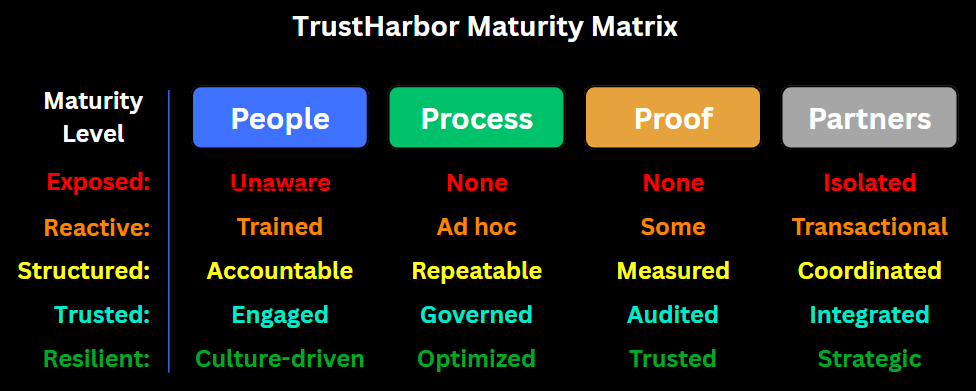
A simplified view of the TrustHarbor maturity model.
This assessment focuses on understanding where you are today, not what is intended or documented.
What you get
- a clear view of your current trust and maturity position
- insight into strengths and opportunities
- prioritized areas for improvement
- a shared language for discussing information security posture
The assessment is designed to be useful on its own, even if no further work follows.
What it is not
- not a compliance audit
- not a certification exercise
- not a risk assessment
- not a sales pitch
A risk assessment is a separate step and is often more effective once priorities are clear.
What happens next
After the assessment, you’ll have a clearer view of your current position and options.
For some businesses, that’s enough. For others, it becomes the foundation for improving the program.
No obligation. The assessment is designed to be useful on its own, even if no further work follows.